Antisocial Personality D. Test
Inquiry Health LLC
4.9 ★
store rating
Free
AppRecs review analysis
AppRecs rating 4.4. Trustworthiness 45 out of 100. Review manipulation risk 28 out of 100. Based on a review sample analyzed.
★★★★☆
4.4
AppRecs Rating
Ratings breakdown
5 star
94%
4 star
6%
3 star
0%
2 star
0%
1 star
0%
What to know
⚠
Rating authenticity concerns
High rating concentration (94% 5-star) in sampled ratings
About Antisocial Personality D. Test
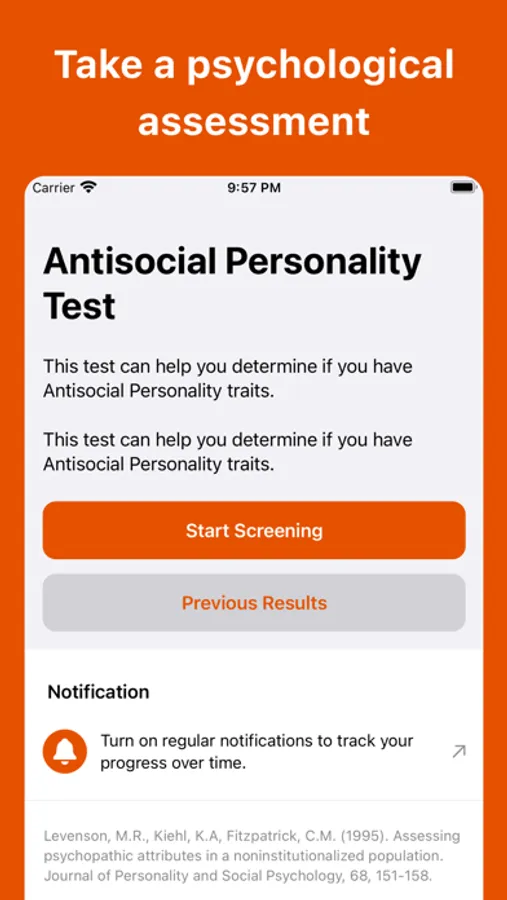
Antisocial Personality Disorder, closely related to Psychopathy and Sociopathy, is a personality disorder characterized by a pattern of disregard and/or violation of the rights of others. If diagnosed in childhood, it is regarded as Conduct Disorder.
People suffering from this disorder often lie, behave violently or impulsively, and have problems with substance abuse. Antisocial Personality Disorder can be diagnosed by a mental health professional. ASPD / ASD and its effects can be treated with psychotherapy and medications.
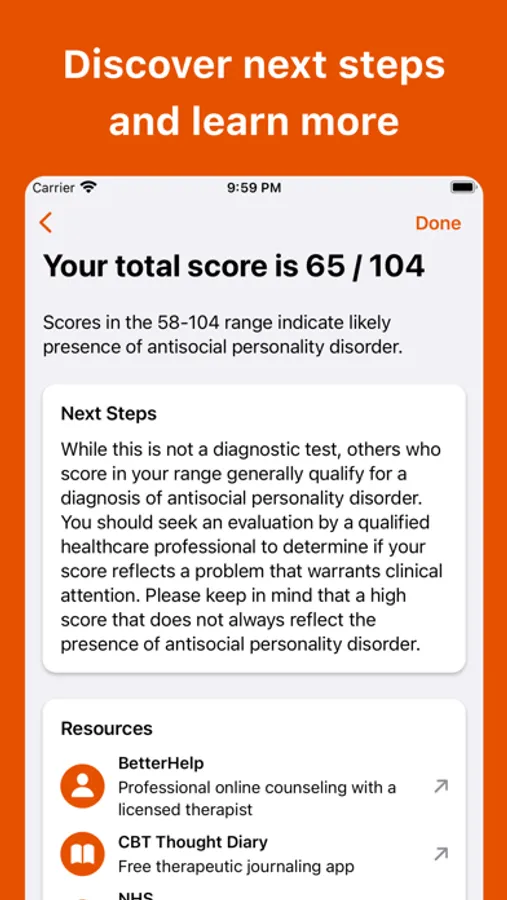
Disclaimer: This test is NOT a diagnostic test. A diagnosis can only be provided by a qualified healthcare professional. Please consult a physician or mental health professional if you are concerned about Antisocial Personality Disorder.
Levenson, M.R., Kiehl, K.A, Fitzpatrick, C.M. (1995). Assessing psychopathic attributes in a noninstitutionalized population. Journal of Personality and Social Psychology, 68, 151-158.
People suffering from this disorder often lie, behave violently or impulsively, and have problems with substance abuse. Antisocial Personality Disorder can be diagnosed by a mental health professional. ASPD / ASD and its effects can be treated with psychotherapy and medications.
Disclaimer: This test is NOT a diagnostic test. A diagnosis can only be provided by a qualified healthcare professional. Please consult a physician or mental health professional if you are concerned about Antisocial Personality Disorder.
Levenson, M.R., Kiehl, K.A, Fitzpatrick, C.M. (1995). Assessing psychopathic attributes in a noninstitutionalized population. Journal of Personality and Social Psychology, 68, 151-158.