Heron Derivation Dictionary
Synthesized Software, LLC
5.0 ★
store rating
$19.99
AppRecs review analysis
AppRecs rating 4.5. Trustworthiness 65 out of 100. Review manipulation risk 29 out of 100. Based on a review sample analyzed.
★★★★☆
4.5
AppRecs Rating
Ratings breakdown
5 star
100%
4 star
0%
3 star
0%
2 star
0%
1 star
0%
What to know
✓
Low review manipulation risk
29% review manipulation risk
✓
High user satisfaction
100% of sampled ratings are 5 stars
About Heron Derivation Dictionary
Gain mastery of English and a greater appreciation of language by understanding the history of words.
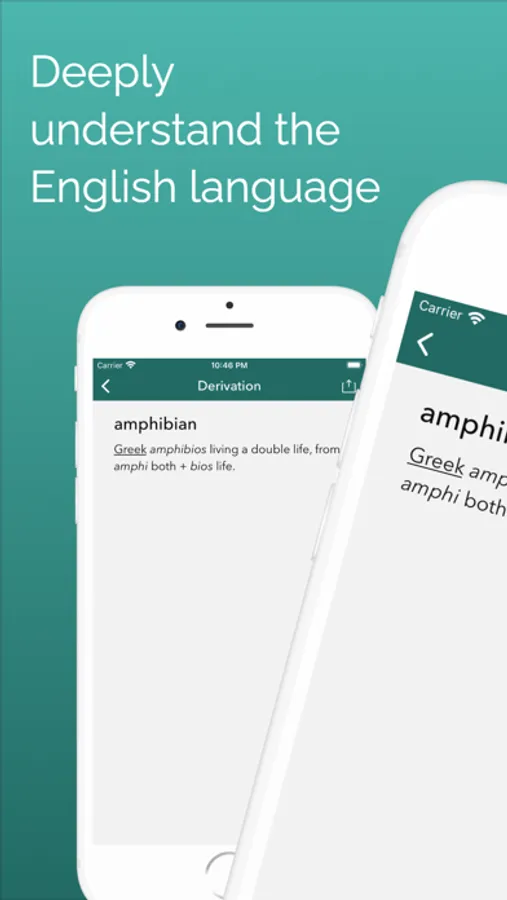
The Heron Derivation Dictionary contains simple and concise derivations for commonly used words. It is perfect for those just beginning their journey into the world of English etymology, or those seeking insight into word origins but find existing etymology resources too complex.
Features:
* Simple, concise and easy to understand derivations
* Approximately 11,450 entries for commonly used words
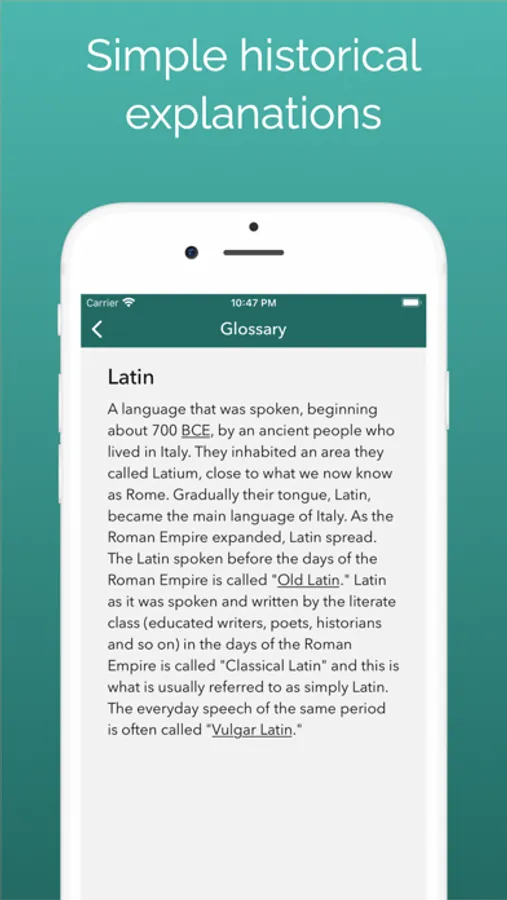
* A glossary of terms (Ex: Old English, Latin, etc)
* One-click links to explore cross-references and glossary terms
-----------------
Why?
-----------------
A derivation gives a more complete understanding of a word by revealing the story of how a word has changed from its original form to become what it means today.
The word "muscle", for example, has a derivation: Flex your upper arm and look at your bicep. What does it look like? Some Roman did this and gave birth to the word we now know as "muscle", which meant "little mouse" in Latin, the language of the Ancient Romans.
Knowing the history of words the words not only gives you deeper understanding of what you are reading, it also unlocks the power to use words in their fullest sense so that you can clearly communicate your ideas to others.
The Heron Derivation Dictionary contains simple and concise derivations for commonly used words. It is perfect for those just beginning their journey into the world of English etymology, or those seeking insight into word origins but find existing etymology resources too complex.
Features:
* Simple, concise and easy to understand derivations
* Approximately 11,450 entries for commonly used words
* A glossary of terms (Ex: Old English, Latin, etc)
* One-click links to explore cross-references and glossary terms
-----------------
Why?
-----------------
A derivation gives a more complete understanding of a word by revealing the story of how a word has changed from its original form to become what it means today.
The word "muscle", for example, has a derivation: Flex your upper arm and look at your bicep. What does it look like? Some Roman did this and gave birth to the word we now know as "muscle", which meant "little mouse" in Latin, the language of the Ancient Romans.
Knowing the history of words the words not only gives you deeper understanding of what you are reading, it also unlocks the power to use words in their fullest sense so that you can clearly communicate your ideas to others.