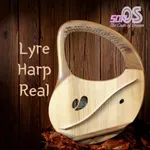
Lyre Harp Real
Son Truong Ngoc
4.9 ★
store rating
Free
AppRecs review analysis
AppRecs rating 3.9. Trustworthiness 45 out of 100. Review manipulation risk 44 out of 100. Based on a review sample analyzed.
★★★☆☆
3.9
AppRecs Rating
Ratings breakdown
5 star
97%
4 star
0%
3 star
0%
2 star
0%
1 star
3%
What to know
⚠
Questionable review patterns
44% review manipulation risk - some review patterns appear unusual
⚠
Unusually uniform ratings
97% of sampled ratings are 5 stars with very little variation
About Lyre Harp Real
The lyre (from Greek λύρα and Latin lyra) is a stringed musical instrument that is classified by Hornbostel–Sachs as a member of the lute family of instruments. In organology, a lyre is considered a yoke lute, since it is a lute in which the strings are attached to a yoke that lies in the same plane as the sound table, and consists of two arms and a crossbar.
The lyre has its origins in ancient history. Lyres were used in several ancient cultures surrounding the Mediterranean Sea. The earliest known examples of the lyre have been recovered at archeological sites that date to c. 2700 BCE in Mesopotamia. [1] [2] The oldest lyres from the Fertile Crescent are known as the eastern lyres and are distinguished from other ancient lyres by their flat base. They have been found at archaeological sites in Egypt, Syria, Anatolia, and the Levant.[1]
The round lyre or the Western lyre also originated in Syria and Anatolia, but was not as widely used and eventually died out in the east c. 1750 BCE. The round lyre, so called for its rounded base, reappeared in ancient Greece c. 1700–1400 BCE,[3] and then later spread throughout the Roman Empire.[1] This lyre served as the origin of the European lyre known as the Germanic lyre or rotte that was widely used in north-western Europe from pre-Christian to medieval times.
(https://en.wikipedia.org/wiki/Lyre)
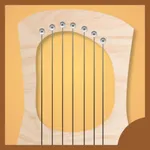
The Lyre Harp Real is Lyre Harp simulation app with 19 strings. Frequency range: F3 → C6.
More offline and online songs for practice (With the ability to change speed).
Play with 3 modes:
- Normal
- Real Time
- Autoplay: You choose this mode for listening songs.
Record feature: record, play back and share to your friends.
Reverb feature
** Songs is updated regularly
The lyre has its origins in ancient history. Lyres were used in several ancient cultures surrounding the Mediterranean Sea. The earliest known examples of the lyre have been recovered at archeological sites that date to c. 2700 BCE in Mesopotamia. [1] [2] The oldest lyres from the Fertile Crescent are known as the eastern lyres and are distinguished from other ancient lyres by their flat base. They have been found at archaeological sites in Egypt, Syria, Anatolia, and the Levant.[1]
The round lyre or the Western lyre also originated in Syria and Anatolia, but was not as widely used and eventually died out in the east c. 1750 BCE. The round lyre, so called for its rounded base, reappeared in ancient Greece c. 1700–1400 BCE,[3] and then later spread throughout the Roman Empire.[1] This lyre served as the origin of the European lyre known as the Germanic lyre or rotte that was widely used in north-western Europe from pre-Christian to medieval times.
(https://en.wikipedia.org/wiki/Lyre)
The Lyre Harp Real is Lyre Harp simulation app with 19 strings. Frequency range: F3 → C6.
More offline and online songs for practice (With the ability to change speed).
Play with 3 modes:
- Normal
- Real Time
- Autoplay: You choose this mode for listening songs.
Record feature: record, play back and share to your friends.
Reverb feature
** Songs is updated regularly